
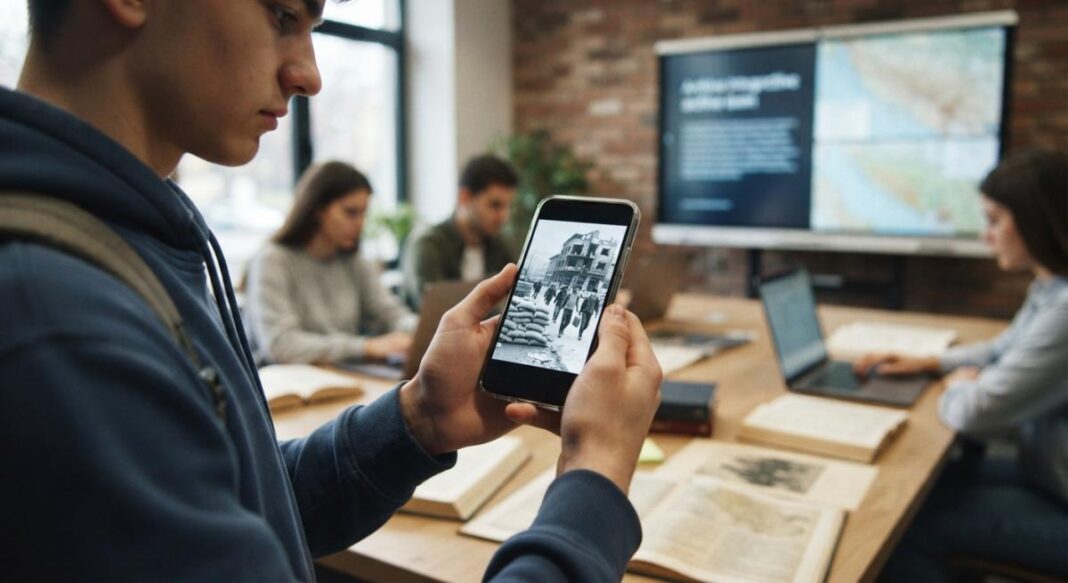

While social media turns war criminals into viral symbols of national pride, and algorithms spread revisionist narratives among young people, the authentic testimonies of survivors face the risk of being forgotten, insufficiently preserved, or difficult to access for new generations. Therefore, the challenge is not only in preserving and digitising them but also in making the testimonies easily accessible to young people, who are increasingly learning about the war's past through social media.
Author: Azra Omerović
In early September, Ratko Mladić, convicted of the Srebrenica genocide, war crimes and crimes against humanity, was buried in Belgrade with official military honours. On social media, the event served as a powerful catalyst for the spread of ethnonationalist narratives and the further deepening of inter-ethnic hatred among young people in Bosnia and Herzegovina
Footage of the funeral, photographs, comments and messages of support continued to circulate on the internet for days after the event. While for some Mladić was presented as a symbol of national pride and a hero, for others he remained what was established by a final court ruling – a war criminal sentenced to life imprisonment for genocide, war crimes and crimes against humanity.
On social media, a cult of personality in which Mladić is glorified as a national hero was further cemented among young people in Serbia and Republika Srpska. In contrast, such posts provoked outrage among users in the Federation of Bosnia and Herzegovina and Croatia, and some of the reactions took the form of inflammatory, nationalist rhetoric that further deepened inter-ethnic divisions and hatred in the digital space.
On TikTok, Instagram and X, revisionist content was spread, including memes mocking victims, as well as videos in which Mladić is presented as a national hero, set to patriotic music and montaged footage. Such content does not just convey a particular interpretation of the past but makes it appealing and easily shareable through emotionally charged messages and formats tailored to a younger audience.
In an interview with the Impuls portal, Dino Cviko, a freelance journalist and assistant at the International University in Sarajevo, states that the big problem is that young people today do not even have to search for extremist content to be exposed to it. It is enough for them to scroll through TikTok, Instagram or another social media platform, pause on a problematic video, watch it to the end or leave a comment.
– Algorithms can recognise such behaviour as interest and start recommending similar content to them. This very easily creates a kind of vicious circle in which a young person is increasingly exposed to the same or similar narratives, including hate speech, the glorification of war criminals and various forms of extremism. It is particularly problematic that such content is often presented as entertainment, humour or patriotism, so young people are not always even aware of the messages they are being exposed to. At the same time, social media's responses often come too late. By the time a piece of controversial footage is reported, reviewed and potentially removed, it may already have had thousands or millions of views, been shared on other platforms, and reached a huge number of young people. Even when the original content is removed, copies of it can continue to circulate on the internet. Of course, this does not mean that every young person who views such content will become radicalised, but continuous exposure can contribute to the normalisation of extremist views and hate speech, warns Cviko.
In the days following the news of Mladić's death and after his funeral, the Detektor portal recorded an increase in posts relativising the crimes committed under his command. Among them were narratives claiming that the expulsion of the population from Srebrenica was allegedly an act of saving civilians. The Register 145a platform, through which citizens report genocide denial and the glorification of war criminals, received around 5,000 new reports following the news of his death. Detektor also found paid posts glorifying Mladić, which Meta only removed after a journalistic inquiry.
Online content and media (il)literacy of youth
Cviko says that in his work with young people, he has noticed that there was a serious problem when it comes to media literacy and critical thinking about the content they consume every day.
– Young people today are extremely skilled at using digital technologies and social media, but that does not necessarily mean they are media literate. There is often a lack of a critical approach to information, that is, a lack of willingness to question who the author of a piece of content is, where the information comes from, how reliable it is, and what message is being conveyed. As a result, they can be very susceptible to the various manipulations, propaganda and narratives they are exposed to every day, he states.
Let us recall a study by Mediacentar that showed that the majority of young people lack basic media literacy skills, the basic knowledge and skills required to participate in public communication and to recognise, protect themselves from, and react to problematic content. Furthermore, their habitual use of media and online content generally keeps them within a one-sided understanding of the world, in line with dominant ethnonationalist policies.
The study has shown that online media platforms and social networks are key sites for spreading ethnonationalist hatred and extremist ideology.
This was also confirmed by a study carried out by the Srebrenica Memorial Centre in 2023 on the practices of genocide denial on TikTok, one of the world's most popular and fastest-growing social media platforms. On TikTok, multimedia forms aimed at young people predominate, consisting mainly of videos, photographs and songs that glorify or support the perpetrators of the Srebrenica genocide.
”The digital age has changed the ways we communicate, do business, and distribute content, and with the appearance and popularisation of social media and the internet, the way we educate has also changed. Therefore, children can now type a term they want to learn about on TikTok and come across denialist content that can misinform them, shaping their opinion and their attitude towards genocide. The romanticisation and glorification of war criminals do not contribute to reconciliation or the discovery of the truth, but rather to propaganda which, in addition to insulting the victims, grossly downplays and denies genocide, slowing down democratic processes”, stated one of the report's authors, Slađan Tomić, at the time.
Furthermore, this analysis has confirmed that the denial of the Srebrenica genocide, encouraged from the highest levels of government, has become widespread throughout all sectors of society, and that entire generations of young people, who most often use TikTok, are exposed to this harmful narrative.
”The analysis, however, showed that in this area too, there is a lack of reaction from the authorities in Bosnia and Herzegovina, who in the previous year were the only ones in the region not to have filed a single report of harmful narratives with this social network. Therefore, the analysis can also serve as a call to representatives of Bosnian and Herzegovinian institutions to become more engaged on this issue in order to protect our younger generations,” warned the report's co-author, Tarik Moćević, at the time.
Young people who lack sufficiently developed media literacy and a critical understanding of the past are particularly exposed to such narratives, especially when they are continuously presented to them through social media algorithms. This risk is further exacerbated by an education system in which young people in Republika Srpska and the Federation of Bosnia and Herzegovina often adopt different, mutually contradictory interpretations of the wartime past. In such an environment, social media become much more than a space for exchanging opinions; they become a place where historical facts are disputed, crimes are relativised, and national identity is built by glorifying convicted war criminals.
Cviko warns that in Bosnia and Herzegovina, we still do not have a comprehensive and unified systemic approach to media literacy for young people. There are certain initiatives and positive examples, but media literacy is not sufficiently represented in education.
– At the same time, we have we have an education system in which children, depending on which part of the country they live in and which curriculum they attend, learn different interpretations of the same historical events, often shaped by ethnonationalist narratives. So, on the one hand, we are not sufficiently developing their ability to critically analyse information, and on the other, we expose them from a very early age to different, often mutually contradictory, interpretations of the past. When this is compounded by social media and algorithms that can further reinforce existing beliefs, we get an extremely fertile environment for the spread of prejudice, polarisation and extremist ideologies, says Cviko.
Denial of genocide and war crimes on social media is not the only example of youth radicalisation in Bosnia and Herzegovina. Let us also recall the two concerts by the controversial Croatian musician Marko Perković Thompson, held in mid-February this year in Široki Brijeg. The concerts were marked by Ustasha chants, fascist salutes, as well as the spread of hate speech and inter-ethnic divisions among young people on social media.
Instead of a clear distancing, the whole affair was given additional legitimacy in the public sphere by Dragan Čović, leader of the HDZ BiH, who called the controversial singer a friend. The events in Široki Brijeg were also condemned by the European Union Delegation in Bosnia and Herzegovina, the UN and the OSCE, and reports have been filed with the BiH Prosecutor's Office against those responsible.
Reactions on social media were highly polarised, ranging from delight in the atmosphere to harsh condemnation and outrage at the behaviour of some in the audience.
A large part of the discussion on social media was fuelled by videos and photographs from the audience. Users who criticised the event focused on the behaviour of a large number of young people, from Ustasha iconography and banners to videos of the audience chanting fascist slogans and using the Nazi salute with a raised right hand. Many expressed deep concern that the younger generations were at the forefront of such behaviour, viewing it as a return to radicalism and the spread of ethnic intolerance.
On the other hand, Thompson's fans and concert-goers shared a completely different narrative on their profiles. They emphasised the spectacular atmosphere, the huge turnout and the fact that the concerts passed without any physical incidents or public order disturbances. Marko Perković Thompson's official Facebook page and his team issued a statement in which they highlighted that the concerts ended with two marriage proposals and tears of joy. They stated that the concert celebrated ”life, togetherness and emotions”, dismissing all accusations of glorifying Nazism or fascism as malicious fabrications.
Can digitalisation improve the culture of remembrance in Bosnia and Herzegovina
While on social media the wartime past is frequently re-edited into short video clips, montages and viral messages, the authentic testimonies of survivors face a different kind of threat – the possibility of being forgotten, inaccessible or physically lost.
According to a report by the Australian Academy of the Humanities from July this year, approximately 20,000 handwritten testimonies from survivors of wartime camps in Bosnia and Herzegovina are located in Sarajevo. Created immediately after their release from captivity, these testimonies represent first-hand accounts of the experiences of people who survived atrocities. However, according to the same report, the documents have not yet been systematically catalogued or digitised.
The problem, however, is not just whether the documents will survive the test of time. It is also whether their testimonies will remain accessible to generations who know of the war only indirectly, often through content on social media. The Srebrenica Memorial Centre, with more than 700 recorded testimonies from survivors and witnesses of the genocide, demonstrates how personal memories can be systematically preserved, processed and archived.
Furthermore, in Bosnia and Herzegovina there are several significant digital archives, platforms and databases that are dedicated to documenting, collecting testimonies and preserving the culture of remembrance of the war in Bosnia and Herzegovina.
The Balkan Investigative Reporting Network Bosnia and Herzegovina (BIRN BiH) through its specialised media outlet Detektor, has developed several key digital databases that serve as educational, journalistic and legal resources for facing the past. Their databases focus on court-verified facts and are designed to counter misinformation and denial of crimes.
The database of court-established facts about the war in Bosnia and Herzegovina is the central and most important platform launched with the aim of preserving the truth. It brings together into one place the final judgments and facts established by the International Criminal Tribunal for the former Yugoslavia (ICTY) in The Hague, and is continuously updated with judgments from the Court of Bosnia and Herzegovina, as well as local and regional courts.
Denis Džidić, Executive Director of BIRN in Bosnia and Herzegovina, recently highlighted the importance of this database for education while speaking to BH journalists, as it allows pupils and teachers to learn about the wars and crimes based on verified information, rather than political interpretations and myths.
”This develops critical thinking, a better understanding of the consequences of crimes, and reduces the scope for manipulating the past”, stated Džidić.
The text was co-authored in cooperation with the Pro Peace BiH.
Impuls