
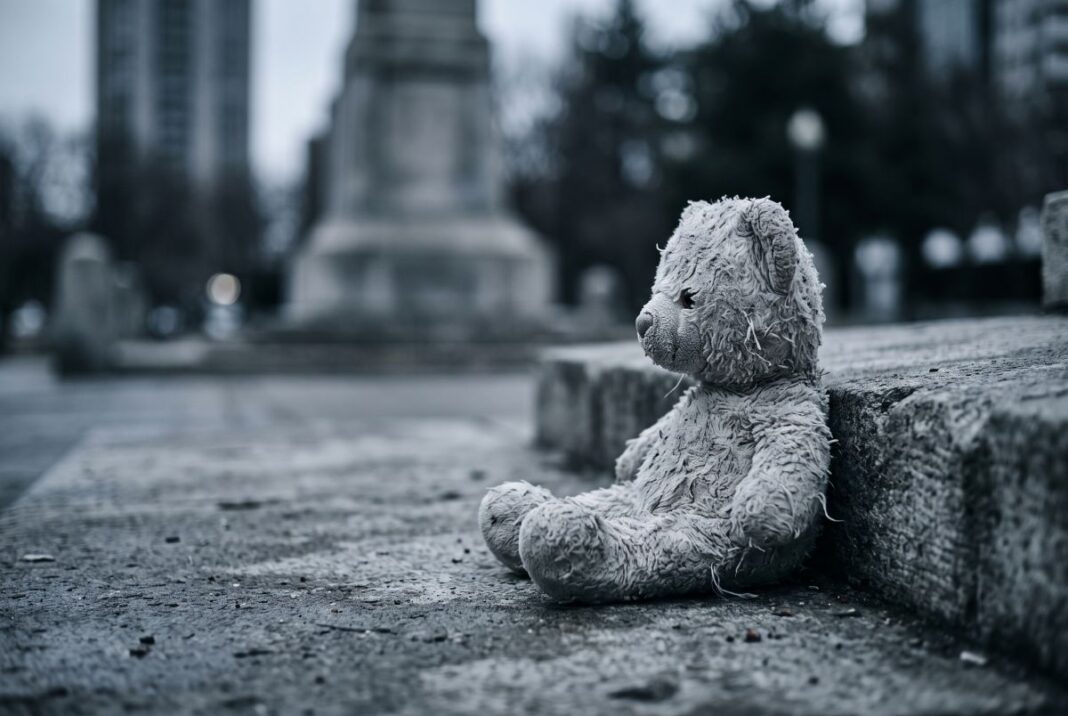

Three decades after the war in Bosnia and Herzegovina, there is still no agreement on a single approach towards victims, even in such cases when victims were only innocent children. The relationship towards memorials dedicated to children victims of war also illustrates this devastating reality.
Author: Miljan Kovač
Memorials do exist in several cities, however, apart from rare cases, they are mostly related to a certain interpretation of the past or a certain ethnic community.
As a result of this, instead of being subjects of memorialisation aiming to contribute to an unbiased facing the past, they frequently become a means of political manipulation. This leads to additional deepening of inter-ethnic divisions.
The same situation applies to the issue of memorials that should have been built by now, but as in the case of Prijedor, such an idea has been systematically obstructed for years, so there is still no memorial dedicated to the 102 children killed in this town. This case perhaps most clearly illustrates this society's devastating attitude towards its victims.
Political obstruction
During the war, 102 children were killed in Prijedor and the surrounding area. The youngest victim was only a few months old. There is no memorial because, as the initiators of the campaign to build the monument say, there is no political will.
According to Edin Ramulić, an activist and fighter for human rights and the truth about war victims, it is absurd that there is actually no opposition from any organisation, group or individual to this monument finally being erected, yet it remains unbuilt.
”What we have is obstruction from people who are primarily holding executive functions of the mayor or a member of the local parliament, who refuse to adopt any decision to proceed with the legal construction of this monument. At the moment, we have a conceptual design and the initiative has existed for about fifteen years, since 2011 or 2012. However, we still have no indication that anything concrete will be done”, Ramulić says for Impuls.
He finds it unlikely that the idea will be implemented this year. The situation is further complicated by the fact that this is an election year in Bosnia and Herzegovina, so politicians are preoccupied with other issues. ”We will probably have to wait for the next year, when things will be more relaxed, for such initiatives to be relaunched”, Ramulić says.
In Prijedor, at least, there is an initiative and only one step is missing – the political will to see it through.
In many places, three decades after the war, the road from idea to implementation is still a long way off.
Admittedly, given the number of victims and mass graves, there are few monuments strictly dedicated to the youngest victims.
According to our interlocutors, these monuments are easy to locate: in Sarajevo, East Sarajevo, Goražde, Banja Luka, Vitez, Konjic and Maglaj.
There are several cases where the names of the children who were killed are found alongside the names of other victims. Frequently, the names of children are inscribed among those of fallen soldiers, which makes further manipulation possible.
We have a situation where the memorials, as Edin Ramulić says, do not speak where they ought to. That is the first problem – the problem of silence.
He believes that the memorials in Maglaj, Goražde or Konjic do speak of a kind of empathy, of sorrow for those children, and carry an anti-war message.
On the other hand, there are monuments which, unfortunately, have a political dimension.
In September 2018, the ”Monument to the Killed Children of Serb Sarajevo” was unveiled in the courtyard of the ”Sveti Sava” Primary School in East Sarajevo. This put an end to the idea of a joint memorial to all the children of Sarajevo who had suffered, regardless of which army controlled the territory where the victims were killed. Nine years earlier, in May 2009, the ”Monument to the Children of Sarajevo” was unveiled in Sarajevo's Veliki park.
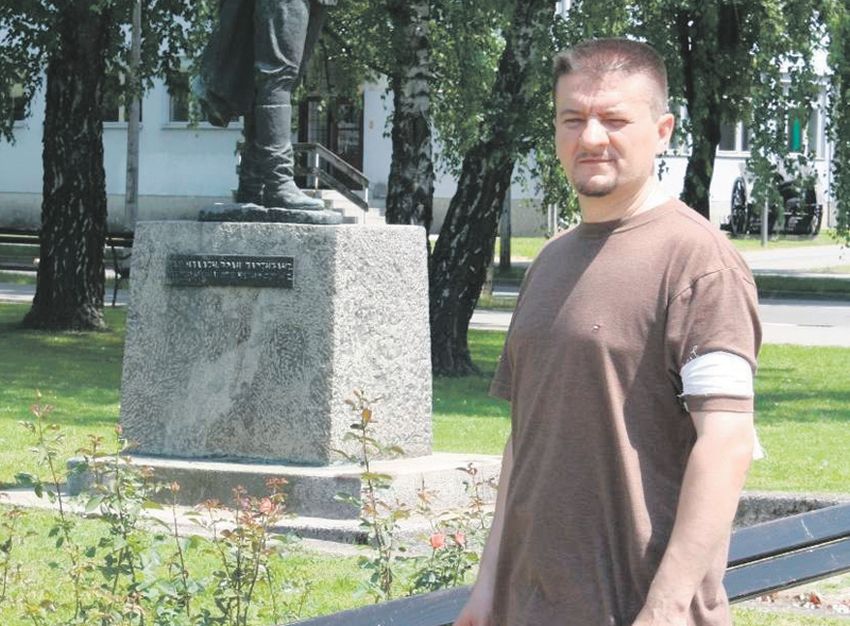
Edin Ramulić
Edin Ramulić says that, to his knowledge, there was an initiative from the then-mayor of East Sarajevo for a joint monument, but it was unfortunately abandoned.
He believes that the very term ”monument to the children of Serb Sarajevo” carries a political dimension. The political term is particularly contentious because ”Serb Sarajevo” no longer formally exists as a geographical designation, so in a way, an attempt was made to politically instrumentalise those children.
”On the other hand, that monument is the result of a lack of understanding among people in the other part of Sarajevo to actually include those children. So there would have been no need for any monument to the children of Serb Sarajevo if there had been one joint monument. Indeed, it was a way for Sarajevo to show that it was the capital and that Sarajevo should have erected a monument to all the children who suffered in Bosnia, regardless of their identity”, Ramulić says.
Trade in pain
A monument dedicated to the Banja Luka babies who died during May and June 1992 has a special place in this story.
According to available data, twelve premature babies died at the Banja Luka Clinical Centre after problems arose with the oxygen supply. The first baby died on 22 May, and the last of the 12 babies on 19 June 1992.
The monument ”Life”, dedicated to the babies, was unveiled in the centre of Banja Luka in 2008.
The tragedy of these families is not disputed. What is the subject of different interpretations is the question of the circumstances in which the babies died, the possibility of delivering medical oxygen, as well as the responsibility of the various parties involved.
For years, various claims have emerged in the public domain about whether there was a way to deliver oxygen, and whether help was available. At the same time, the official narrative of the Republika Srpska largely presents this event as a consequence of the wartime blockade and the UN Security Council's decision to ban international flights.
”The most terrible thing of all is that this monument, or rather the memory of those children, is politicised in the same way every year. Politicians come, primarily those in power, lay wreaths, the media covers it in the same way, and in fact, no message of peace is conveyed from such an event”, says Banja Luka-based journalist Gordana Katana.
She also cites the example of political messages that can occasionally be heard at the commemoration of the babies’ deaths.
”After all, the talk of how someone will one day sue NATO or the European Union over the sanctions imposed on Serbia and the airspace ban remains just a dead letter on paper. That is why it is a very contradictory message.”
Katana believes that all monuments erected, and those that may one day be erected, to the victims of war, and especially to children, must convey a strong anti-war message.
”In fact, all monuments that have been built and those that might one day be built must convey the strongest possible anti-war message. Children are perhaps the greatest collateral damage, but also the innocent victims of the crimes committed in Bosnia and Herzegovina during the war”, says Katana.
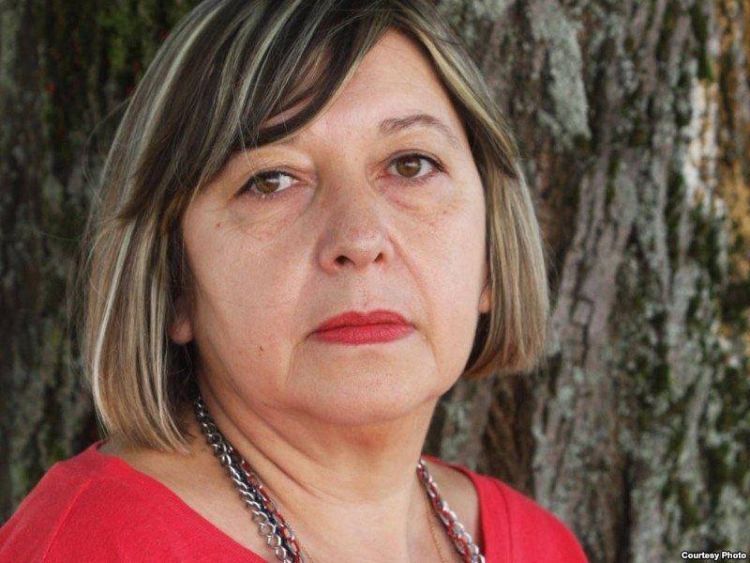
Gordana Katana
However, the problem, she points out, is that in certain cases there is a strong politicisation – both of the very number of children killed and of the way in which this is presented to the public.
”The second problem in all this is the extent to which, in certain cases, there is a politicisation, so that the very number of children killed, and the fact that they were killed is used to convey a different message. Such monuments are the least likely to convey an anti-war message and are the least concerned with fostering a culture of remembrance and facing the past”, believes Katana.
When the number becomes more important than the names
Another problem is the constant battle over the numbers. In Sarajevo, the question of the number of children killed has been the subject of public debate for years. The Institute for Research of Crimes against Humanity and International Law at the University of Sarajevo announced that, using a scientific methodology, it had arrived at the figure of 1,601 children killed during the siege of Sarajevo.
At the same time, the monument in Veliki park was created based on data collected earlier, and the names of the children for whom relevant documentation was then available were inscribed on it.
Our interlocutors agree that the numbers are important for establishing facts. However, they warn that the memorialisation should not be turned into a competition to count ”our” and ”their” victims.
Journalist Rubina Čengić goes a step further. She warns that the attitude towards children who were victims of the war should be viewed in conjunction with the attitude towards children living in Bosnia and Herzegovina today.
”Children were victims in this war of ‘ours’, just as in any other war – they lost parents, lived in cold and wet conditions, without food, sunshine, play and love. And then they were exploited for political or, even worse, for immediate political purposes,” says Čengić for Impuls.
According to her, one of the problems is that even today there are no complete and reliable data on the children who were killed, while their numbers are often manipulated.
”There is no record of the children who were killed, the numbers are exaggerated, as is the case in the Federation of Bosnia and Herzegovina, and their deaths are also misused for other purposes, as in the case of Republika Srpska and babies who died in incubators”, states Čengić.
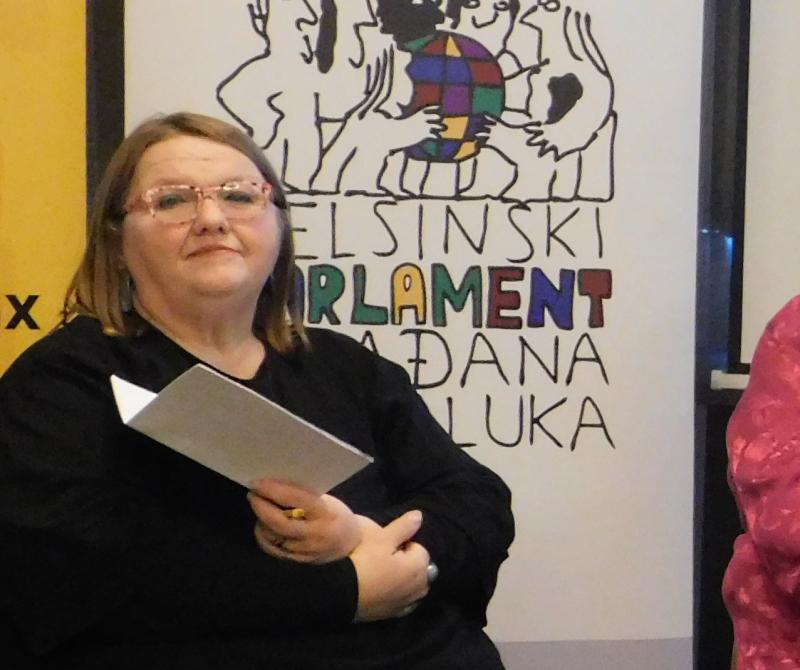
Rubina Čengić – Foto: Impuls
Speaking about monuments dedicated to children who were killed in the war, she points out that there are not enough of them, but that the problem is not just their number.
”If we talk about monuments, there are not enough of them. In those cases, when they exist, children are again being misused. They are only spoken of on dates that suit the current government.”
She believes that the attitude towards the memorials and the memory of the murdered children shows that society is not sufficiently prepared to face its own responsibility.
”The most important thing is that the memorials, our overall behaviour towards children, towards the memorials and towards remembrance show that we have not learnt anything or that we do not care. We are not showing that we are ready for everyone to take their share of responsibility.”
”A monument to the murdered children of Sarajevo without all their names, or a monument to the babies who died in incubators in Banja Luka, means nothing until we all acknowledge what happened and say: never again. Not just ‘never again war and killing’, but also never again irresponsible and destructive politics in healthcare, education, social welfare and other areas.
In her words, a true attitude towards the children who were killed cannot be concluded with wreath-laying and anniversary commemorations.
”The best monument to the murdered children would be responsible behaviour towards the living ones.”
She nevertheless believes that we have learnt nothing from the bloody past.
”One sad, and especially a dead child, is one too many and there is no justification for it. But if we had learnt anything, we would look ourselves in the eye and acknowledge our responsibility, not make an issue of, say, a monument to the murdered children in Prijedor or a list of children killed in Sarajevo.”
The text was co-authored with Pro Peace BiH.
Impuls