
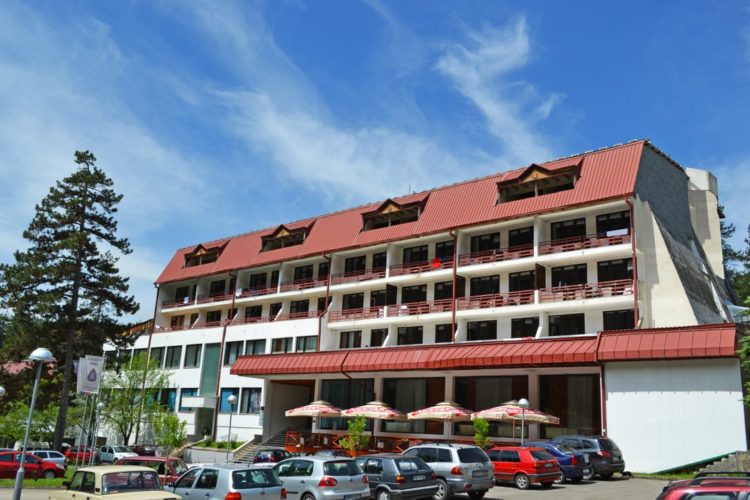

Photo: Turistička organizacija opštine Višegrad
More than three decades after the war, the spa hotel Vilina vlas remains the subject of two completely different interpretations. While local authorities promote the facility as part of Višegrad's tourist offering, human rights organisations and victims’ associations warn that the site has never been adequately marked as a place of wartime suffering, nor has its history been publicly acknowledged.
Author: Azra Omerović
Situated in a dense pine forest a few kilometres from Višegrad, the town of Višegradska Banja has the characteristics of a health resort due to its altitude and natural surroundings. The waters of Višegradska Banja are used to treat rheumatic diseases, neurological conditions, orthopaedic diseases and deformities, gynaecological, respiratory and geriatric diseases.
According to the Tourism Board of the Municipality of Višegrad, the driver of tourism development in Višegradska Banja is the hotel and rehabilitation centre Vilina vlas.
“It is a 3-star hotel, with 160 beds, and two restaurants with a total capacity of 370 seats. The hotel has an indoor swimming pool with thermal mineral water and a well-equipped medical department where various baths, electrotherapy, paraffin therapy, water massages and other treatments are applied”, states the official website of the Višegrad Municipality Tourism Board.
Today, Vilina vlas is advertised as a place for holidays, rehabilitation and wellness tourism with a tradition spanning more than 400 years. Tourist brochures speak of health, nature and tradition, while guests from the region and abroad book their stays, often unaware of the past of the place they are staying in.
Behind the image of a tourist destination lies a dark history. According to numerous testimonies, court judgements and reports by international organisations, in 1992, the spa hotel Vilina vlas was converted into a detention camp where Bosniak women and girls were brought and systematically mistreated, raped and sexually abused. It is one of many facilities and locations in Bosnia and Herzegovina where wartime sexual violence was committed .
The representatives of the association ”Women Victims of War” warn that Vilina vlas, regardless of its wartime past, today functions as a tourist and rehabilitation complex without an official memorial.
– For the surviving victims and the families of the murdered persons, this represents a deeply painful and devastating attitude towards the past. The absence of any public recognition of the crimes conveys a message of denial, silence, and institutional neglect towards the victims, the association states.
A historian and member of the Nonviolent Action Centre team, Nedžad Novalić, states that there is a huge number of places of suffering that are not marked in any way. As a rule, these are places of suffering where the victims are from the ethnic group that is now a minority in those areas, and in case of which the responsibility for the war crimes and suffering lies with individuals and groups from the ethnic group that is now the majority and holds real power.
The Centre for Nonviolent Action has so far mapped around 150 such sites in Bosnia and Herzegovina, Croatia and Serbia. One of these is Vilina vlas. Novalić states that such places have been recognised despite opposition, at least by part of the public, as sites of suffering; people visit them, pay tribute to the victims, and these efforts, as well as the people who support them, should always be recognised and supported.
– It would be important for such places to be marked in some way as places of suffering before their primary function is restored. Speaking from a personal perspective, I wouldn't feel comfortable staying overnight in any place if I knew that someone had suffered there, that crimes had been committed there. It's not just about tourist places, hotels and the like. We have mapped schools that were used as detention facilities. Today, classes are held in them, and the buildings are in no way marked as places of suffering. For example, in my hometown of Zenica, this is the case with the Music School, which was a detention facility for Serbs and Croats. Also, a huge number of police stations, courts and cultural centres had the same purpose during the war. These are public institutions; imagine someone coming to a court seeking justice, and that same court has not had the strength to confront its own past,” says Novalić.
Between war past and tourism
The rehabilitation centre Vilina vlas is owned by the municipality of Višegrad. According to information published on the municipality's official website, as well as by the management of the Vilina vlas company, it has stable operations and development. The wartime past does not appear to affect the centre's business.
The official, comprehensive report on the work of the rehabilitation centre Vilina vlas is not publicly available, but at the end of January this year, the municipality of Višegrad announced that the rehabilitation centre Vilina vlas would receive its first guests in the newly built fourth floor from February, thereby significantly expanding its accommodation capacities and improving the quality of its services.
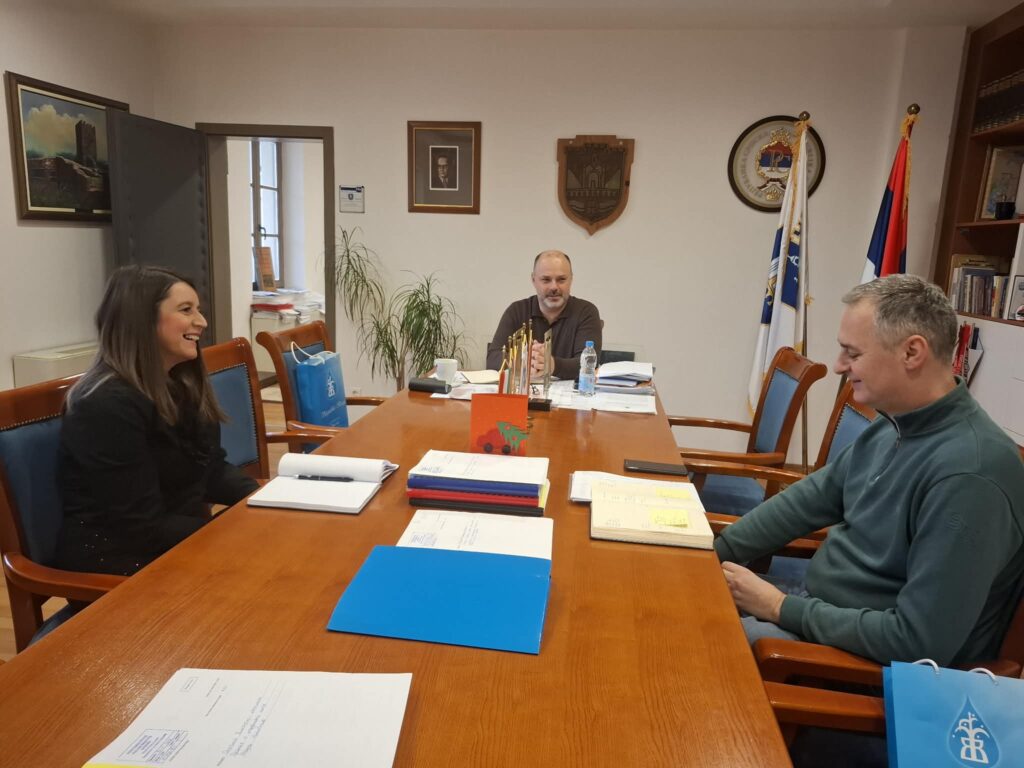
Photo: Opština Višegrad
The director of the rehabilitation centre, Brankica Stikić, stated at a recent meeting in the municipality of Višegrad that the centre's current accommodation capacity was around 140 beds, and that with the construction of the fourth floor, Vilina vlas would get 14 apartments and three double rooms, which represents around 50 new beds.
”All the newly built apartments are equipped with state-of-the-art equipment, and the completion of their furnishing and the arrival of the first guests are planned for as early as next month”, stated Stikić.
The Mayor of Višegrad, Mladen Đurević, praised the work of the rehabilitation centre, stating that the institution's founder was the municipality, but that Vilina vlas did not operate at the expense of the municipal budget.
”The rehabilitation centre Vilina vlas fulfils all its obligations independently, operates successfully and is an example of responsible management of a public institution”, said Đurević.
The centre's director, Stikić, stated that clients of the rehabilitation centre Vilina vlas came from Republika Srpska, Serbia and Montenegro, and that this year they would, for the first time, also host clients from Slovenia.
”A contract has been signed with partners from Slovenia for a group of around 50 guests, who will stay at our centre for 10 days in September”, stated Stikić.
The municipality also stated that the new accommodation facilities at Vilina vlas would further strengthen Višegrad's health and wellness tourism offering.
We sent enquiries to the Višegrad municipality and the rehabilitation centre Vilina vlas, focusing on the relationship between memorialisation, local development, and the current economic function of Vilina vlas. We had not received a response at the time of publication.
That the wartime past of Vilina vlas does, however, have some influence on the business of this company was shown by the recent termination of cooperation with the Montenegrin Education Trade Union. The Centre for Civic Education (CGO) from Montenegro and the Association for Social Research and Communications (UDIK) from Bosnia and Herzegovina recently invited the Education Trade Union of Montenegro (SPCG) to end its cooperation with the rehabilitation centre Vilina vlas.
“We appreciate that the SPCG has recognised the seriousness of this issue and responded positively to our initiative, and terminated its cooperation with the spa hotel Vilina vlas this year. We would like to remind you that during the war in Bosnia and Herzegovina, Vilina vlas was a detention camp where around 200 Bosniak women were raped. This fact places a special responsibility on all institutions and organisations to be mindful of the symbolic and real significance of the spaces they choose for collaboration”, the Association for Social Research and Communications (UDIK) stated recently.
It should be recalled that earlier, the two organisations had addressed the Pension and Disability Insurance Fund of Montenegro with an initiative, demanding the termination of its cooperation with the rehabilitation centre Vilina vlas, and the fund subsequently terminated the contract. The organisations stated that this is an important “step towards a more responsible approach to the past and respect for the victims, but also a reminder of the need for ethical criteria to be consistently incorporated into all institutional policies and programmes”.
Over the years, there have been initiatives and calls for this site to be properly marked, states the association Women Victims of War, but the competent institutions failed to respond to them.
It is precisely this institutional resistance or silence that further complicates the process of facing the past. Instead of erecting memorials and engaging in memorialisation, institutions and local authorities in Višegrad have for years actively opposed these initiatives.
– We regularly and publicly condemn the promotion of Vilina vlas as a tourist destination at fairs in the country and abroad, emphasising that the hotel was a notorious detention camp for torture and systematic rape during the war in Bosnia and Herzegovina. The association's aim is for sites like Vilina vlas to be adequately marked, so that the crimes are never forgotten or denied, said a representative of the association Women Victims of War, stating that without a clear marking of crime scenes, it was difficult to speak of true justice and reconciliation. Survivors often feel that society expects them to move on without first acknowledging what they have been through. This deepens the trauma and creates an additional sense of injustice.
Nedžad Novalić, a historian and member of the team at the Centre for Nonviolent Action, states that from his experience of meeting with victims and their families, he can say that their fundamental need is for the suffering they endured to be acknowledged and not denied.
– If someone has lost their loved ones and you do not allow them to erect a memorial there today, you deny that a space was a place of detention, you make access difficult, this conveys a clear message to people that they are still being treated as ”others”, as ”enemies”. Consequently, this creates a sense of fear and mistrust, and all of this leads to the breakdown of peace, says Novalić.
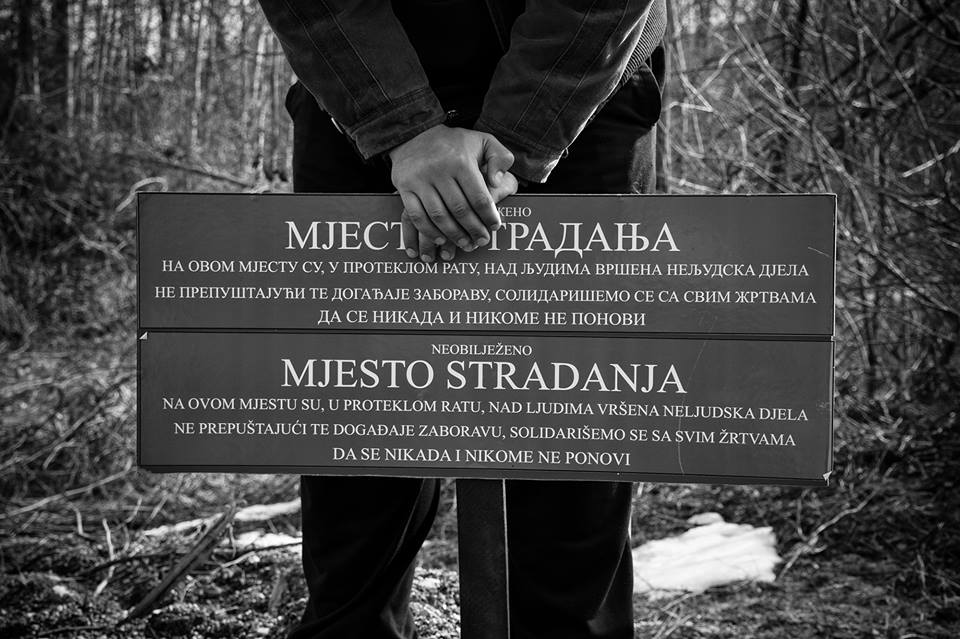
Photo: Centar za nenasilnu akciju
The representatives of the association Women Victims of War believe that the economic or tourist function of such places cannot be entirely legitimate without the clear and dignified acknowledgement of the crimes that took place there.
– Memorialisation does not mean a prohibition of life or development, but rather assuming responsibility and showing respect for the victims. Numerous places of suffering around the world show that it is possible to combine a culture of remembrance with socially responsible management of space, states the association Women Victims of War.
Nedžad Novalić, a historian and member of the team at the Centre for Nonviolent Action, shares a similar opinion, stating that it is clear that not all sites can become monuments and remain permanently closed, but some of the most significant buildings and locations should certainly have that museum role.
– But schools, courtrooms, cultural centres, hotels – most of them have continued to be used, and today they mostly serve the purpose for which they were originally built. It would be fair to find a way to put up a plaque, erect a small monument or something similar, to indicate that the building had a different role at one time and that some people suffered within it. For all of us, this could serve as a warning of how war can turn even the most noble of things and buildings into places of torture, from schools to sports halls. Imagine the people who were imprisoned in the classroom where they completed their primary school education, in a space that for most of us evokes the fondest memories of childhood! And there were many such classrooms. These memorials could also be a kind of hope that, as a society, we have come to terms with what happened to us and have nevertheless managed to move on, an example of strength and of life triumphing over suffering and adversity, says Novalić.
The greatest issue in marking Vilina vlas lies in the local authorities, states the association Women Victims of War, because the local authorities in Višegrad are removing any mention of the crimes that took place in this building, and this approach contributes to a culture of denial and further undermines the possibility of building trust between communities.
– A dignified model for marking Vilina vlas site would involve an official memorial, public acknowledgement of the crime, educational content on war crimes, and an institutional guarantee that such crimes will never be repeated, says the association Women Victims of War, warning that the culture of remembrance in Bosnia and Herzegovina still largely depends on the work of associations, individuals and victims’ families, while the institutional approach remains inconsistent and often burdened by political divisions. It is for this very reason that civil society bears the greatest burden of preserving the truth and memory.
– There are many examples where memorialisation, education and the contemporary use of space have been successfully combined, says Novalić. Prijedor is one example, where the Keraterm and Trnopolje detention camps have been marked and nobody touches these monuments.
– In Zavidovići, the authorities allowed the Serb community to mark a site of suffering that had been unmarked for years. In Sarajevo, the site Kazani has been marked; perhaps the inscription on the monument and the location are not the best solution, but it is a step forward. We have also found that current owners of the buildings we went to in order to mark them as unmarked sites of suffering support the idea and the activity when it is presented to them that we are doing it in an honest and non-selective way, where we equally respect all victims. In Žepče, a man told us he knew what had happened in that silo; he didn't have the strength to start the process himself, but he was happy to let us enter the space with former prisoners. For them, it meant a great deal; for the first time, they had the opportunity, as free men, to enter the place where they had been imprisoned. So it is important to present this to people as a fair approach to the past, to the victims and, ultimately, to future generations to come. Some people will understand and support it, others will not for various reasons, but we mustn't give up”, says Novalić.
The text was co-authored in cooperation with Pro Peace BiH
Impuls