
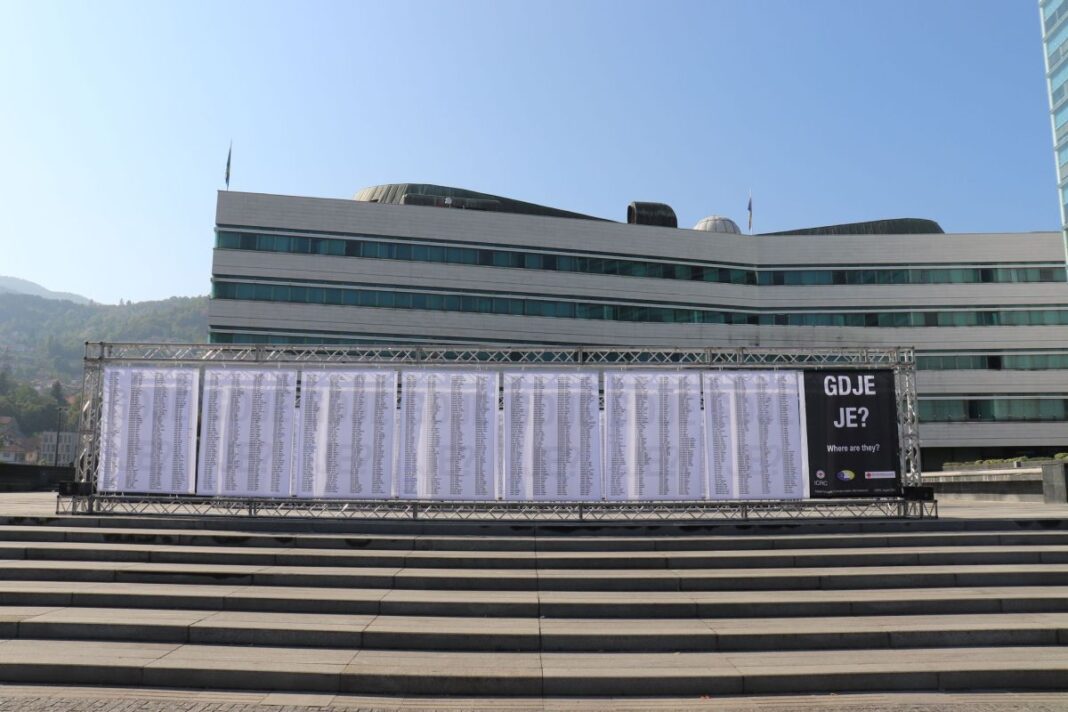

An exhibition with the names of more than 7,600 missing persons in BiH, placed in front of the Parliament building in Sarajevo during the celebration of the International Day of the Missing in 2024; Photo: FB page of ICRC Bosnia and Herzegovina – ICRC BiH
The Institute for Missing Persons of Bosnia and Herzegovina is frequently a ”hostage” of a complex political system, in which the lack of budget funds is directly prolonging the agony of families that have been waiting to find the mortal remains of their family members for decades.
Author: Zinaida Đelilović
More than 7,500 persons in Bosnia and Herzegovina are still registered as missing, and their families have not given up the search for truth and justice in spite of the years that are passing by. In compliance with the Law on Missing Persons of Bosnia and Herzegovina, a missing person is ”a person whose family has no news about them or a person reported as missing based on reliable information due to the armed conflict that took place on the territory of the former Socialist Federal Republic of Yugoslavia”. Although important results have been achieved in identifying victims, and more than 80% of the missing have been identified, the remaining cases constitute the most difficult and uncertain part of the process today. What makes everything even more difficult is a lack of information, resources and political obstructions.
Three decades after the war, the search for the missing is entering its most complex phase. As opposed to previous years, when mass graves were discovered that were even visible based on satellite images, today the focus lies on microlocations and individual or secondary graves that are extremely difficult to find without precise testimonies.
Key issues
The Institute for Missing Persons of Bosnia and Herzegovina faces multiple challenges in the process of searching for the missing. According to Emza Fazlić, the PR of the Institute for Missing Persons of Bosnia and Herzegovina, one of the greatest issues is the lack of accurate and precise information about the location of graves. Those who know where the graves are located keep quiet. They are hiding the information due to their fear from sanctions or fear from revenge by members representing certain ideologies that are still present in our society.
”Many graves were deliberately moved in order to conceal the crimes. As a result, the pain and agony of families of all missing persons we are still searching for in our country are indefinitely prolonged”, Fazlić says.
A key issue is a lack of resources at the Institute, which directly slows down the search. It is necessary to ensure a higher number of investigators on the ground, but also more modern equipment, such as ground-penetrating radars and other advanced technological systems, which is particularly important given the changes to the terrain and land configuration since the war.
”The Institute for Missing Persons of Bosnia and Herzegovina is directly dependent on the budget of institutions of Bosnia and Herzegovina and any ”bottleneck” regarding the state budget has a direct impact on the operations of the Institute in locating graves in both entities, turning a humanitarian issue into a political pressure tool”, Fazlić points out. She reminds us that every exhumation entails significant costs, from the deployment of machinery to securing the site.
According to her, the Institute is frequently a ”hostage” of a complex political system, in case of which a lack of budget funds directly prolongs the agony of families that have been waiting to find the mortal remains of their family members for decades.
”The procurement of drones, ground-penetrating radars and sophisticated terrain-mapping software depends exclusively on capital grants from the budget of Bosnia and Herzegovina, which are often the first to be impacted by austerity measures”, Fazlić says.
Due to insufficient funds from the national budget, the Institute has relied on donations from the EU, USA and ICMP for years.
”The state of Bosnia and Herzegovina has failed to take full financial responsibility for finding its citizens; this process largely depends on projects financed by foreign donors”, Fazlić says and adds that there are fewer and fewer donors, especially in the light of global events and reallocation of funds to other crisis zones.
”We believe that politics is very much obstructing the process of searching for missing persons, since for some, revealing the locations of mass graves would also mean acknowledging direct responsibility of war-time authorities, which is the reason why information is deliberately being withheld. The rhetoric present in society, which includes the denial of crimes and glorification of perpetrators, further discourages those who might have the courage to speak out about grave sites. Moreover, such an environment encourages them to remain silent”, Fazlić concludes.
She explains that the process of closing a case is possible only once DNA identification confirms the identity of a victim and their remains are handed over to the family. According to her, families are informed about the discovery of mortal remains as soon as DNA analysis results are received by the Institute.
”This information is communicated to the families by the investigator in charge of the case. Subsequently, an agreement is reached regarding the official identification, when the families are presented with a DNA report and all known information concerning the death of their loved ones. They then accept the DNA finding, and the final burial of the victim is agreed upon”, Fazlić says.
Families of missing persons share the same views
The fates of families who are still searching for their loved ones best illustrate the scale of this issue. Šehida Abdurahmanović from Srebrenica is still searching for her brother’s remains, while painfully recalling the loss of her husband and numerous family members killed during the war. Her story is one of many that testify to the long-standing struggle of families of missing persons to find the truth and bury their loved ones with dignity.
Speaking of the years of uncertainty, Abdurahmanović points out that the search for remains is the only way for families to find at least some peace. ”Our only comfort is to find the remains and to know where our loved one is buried”, she says.
She also recalls the moments when her husband was taken away, after which he was killed, while her brother’s fate remained unknown. Although there are testimonies that he was captured and killed, she has never found the location of his remains. A witness, one of the neighbours she grew up with, only spoke to her once, saying that her brother’s body had been thrown into the river Drina and that she may not speak about it. He has since passed away, and she has never learned the truth.
According to her, in recent years the process of finding missing persons has slowed down considerably. While in the first years after the war mass graves were discovered and visible results were achieved, the last ten years have been increasingly difficult. She mentions undiscovered graves, but also a complex and lengthy identification procedure as a key issue.
”The procedure of discovery, exhumation, identification, and arrival to Potočari, where they are to have their final resting place, is extremely long, and arduous. I am no longer optimistic and see no end to this process”, Abdurahmanović says.
However, she stresses that the search may not stop, regardless of how much time passed and how modest the results are. She also adds that institutions should intensify their efforts to find all missing persons, regardless of their ethnicity. At the same time, she points out that, what matters for families is not how long the process is or how much it costs, but rather that the truth is finally found and a dignified burial can take place.
Another one among thousands of stories awaiting an epilogue is that of Aljonka Dželetović, who has been searching for her brother, who went missing in Mostar, since 1992.
According to her, her brother was captured alive and taken for questioning. After this, he disappeared without a trace. Despite the passage of time, she is convinced that the answers exist, but are being withheld due to silence and a lack of institutional will.
”Mostar is a small town, it is impossible that people do not know where these people are. This is the silence of politics”, Dželetović says. She used to be a member of the Advisory Board of the Institute for Missing Persons of Bosnia and Herzegovina for a while.
She is particularly critical of judicial institutions, pointing out that there were torture chambers for Serbs in Mostar, but that there has not been a single conviction.
”How can I be satisfied? If there are no results, there is also no trust”, she says.
However, she emphasizes that families are not asking for anything other than justice, and that this is not a political, but rather a human rights issue.
”We speak with one voice”, Dželetović says, adding that the families of victims, regardless of their ethnicity, highly respect each other and their common goal – finding the missing and bringing those responsible to justice.
It is these personal stories that make it clear that many families have not yet attained their right to the truth, since they are unable to find closure and put the painful chapter behind them without any information about the fate of their loved ones. Families of the missing, regardless of their ethnicity, share a similar view – that the right to the truth must be above politics.
During the war in Bosnia and Herzegovina, in the period between 1992 and 1995, a total of 32,000 persons went missing. Out of this number, more than 80% of the missing have been identified to date. Key factors hindering the recovery of the remaining 7,500 missing persons include a lack of, or deliberate concealment of, accurate information, but also the relentless passage of time. As frequently stated, ”witnesses die, and perpetrators remain silent”, thereby irreversibly reducing the chances of finding the remaining victims.
These challenges are also highlighted by the International Commission on Missing Persons (ICMP). The Commission stresses that resolving the remaining cases largely depends on the availability of new and credible information about the sites of hidden graves, many of which have yet to be found.
Although Bosnia and Herzegovina has established key institutions tasked with the resolution of this issue, the ICMP points out that their operational capacities need to be continuously strengthened, especially in the field of forensic science and archeology.
Political polarisation is slowing the process
”At the same time, the wider political context continues to affect the pace of progress. Deep political polarisation in Bosnia and Herzegovina is still a significant obstacle to uncovering new information and ensuring consistent cooperation among institutions. This unresolved issue is not only prolonging the agony of families of the missing, but also impacting broader social stability, hindering normalisation and jeopardising the prospects for sustainable and long-term peace”, the ICMP states.
They add that resolving these challenges requires a continued commitment to transparency, accountability and substantive cooperation between institutions, as well as an inclusive dialogue that primarily focuses on the rights of victims and their families.
The ICMP-a emphasizes that the right to the truth implies the right of victims and society to know the fate and whereabouts of missing persons, as well as the circumstances of their disappearance, and that it is both a human rights principle and a legal obligation for states to conduct effective investigations and ensure access to information.
”In Bosnia and Herzegovina, this right is institutionalised through a comprehensive legal and institutional framework. This country was the first in the region to adopt a Law on Missing Persons that guarantees the protection of this right. It has also established specialised institutions tasked with the coordination of the work on locating missing persons. Investigations are carried out by the Prosecutor’s Office of Bosnia and Herzegovina based on court orders, which ensures that the process takes place in compliance with the rule of law”, representatives of the organisation say.
They also point out that families of the missing are key actors in the process, with the right to participate and advocate, and that the whole process takes place in accordance with international standards.
Finally, in their opinion, the authorities in Bosnia and Herzegovina should take on a stronger leading role in the process.
”This implies stable financing, clearly defined institutional competences and preservation of political independence”, the ICMP concludes.
The text was written in cooperation with Pro Peace BiH.
Impuls