
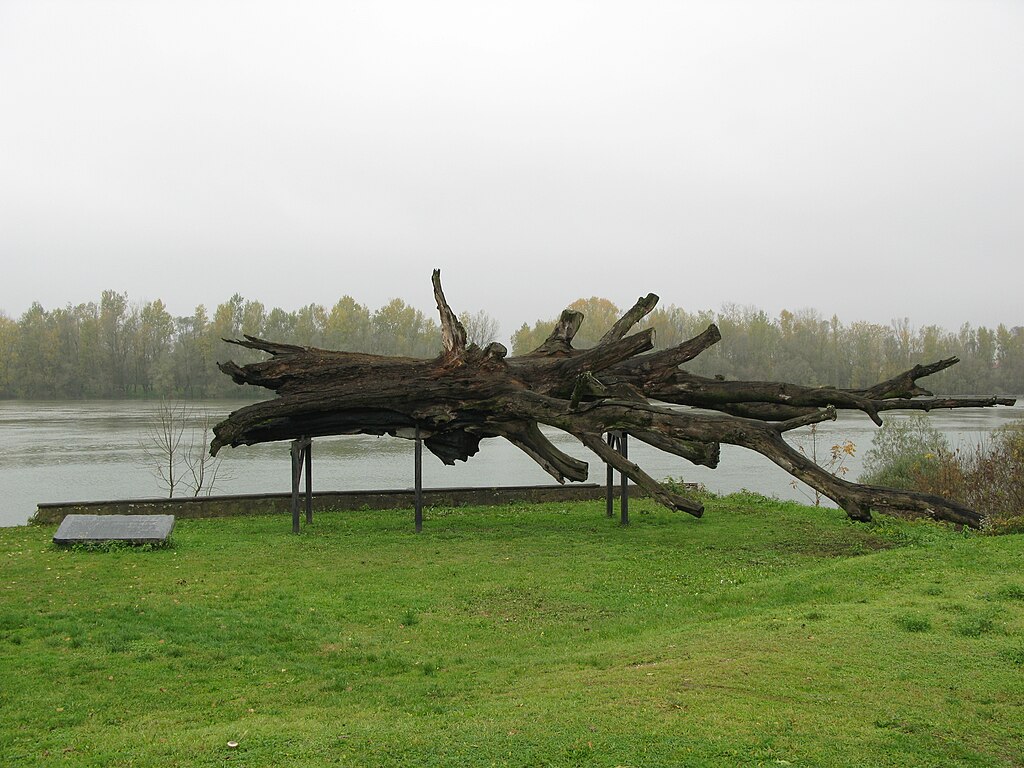

Photo: Petar Milošević/Wikipedia
The Government of Republika Srpska has been organising a central commemoration event dedicated to victims of Jasenovac and the Independent State of Croatia* over the past twenty years in Donja Gradina, the largest site of suffering of the Ustasha concentration camp Jasenovac. This was the case on April 27 of this year, too.
Author: Milkica Milojević
As always, the President of Republika Srpska, the President of Serbia and representatives of the Jewish and Roma community from Serbia spoke during this gathering.
Representatives of the other two constituent peoples in Bosnia and Herzegovina, Croats and Bosniaks, were absent from the commemoration in Donja Gradina this year, just as during previous years.
Bosnia and Herzegovina, which used to be proud of its anti-fascist tradition, faces a situation in which even partisans and their descendants are divided along ethnic and entity lines.
For example, the anniversary of the famous Battle on Sutjeska is held two times: once organised by the Government of Republika Srpska and the Union of Associations of National Liberation War Veterans of Republika Srpska (SUBNOR), and several days later organised by the Association of Anti-Fascists and Veterans of the National Liberation War of Bosnia and Herzegovina (SABNOR) (1).
Unfortunately, neither the dates of the great anti-fascist battles nor the collective memory of the victims of World War II have served as a foundation for building trust among the peoples and citizens of Bosnia and Herzegovina.
On the contrary, on several occasions over the past years, the commemoration of the victims of Jasenovac in Donja Gradina was even used to deepen divisions and create heated political confrontations.
Why is this happening?
According to some analysts, one of the reasons for this is the persistent ”serbisation” of both anti-fascism and commemoration of victims of fascist terror. And that is an opportunity that some Bosniak politicians cannot miss. The representatives of Croats in Bosnia and Herzegovina have been ”wisely silent” so far, but they do not attend the commemoration in Donja Gradina.
This year, during the commemoration in Donja Gradina, the former president of Republika Srpska, Milorad Dodik, once again made headlines with his statement that Serbs were the greatest victims and anti-fascists.
-500,000 Serbs, 33,000 Jews, 40,000 Roma and 120,000 antifascists, mostly Serbs, were killed here. Because Serbs here rose up against the fascists, and those with whom we lived in a common state, were evil; Muslims served the interests of Croats and their Handschar division committed massacres in Serb villages, said Dodik (2).
The commemoration in Donja Gradina was organised jointly by the Committee for the Preservation of the Tradition of Wars of Liberation of the Government of Republika Srpska and Committee for the Preservation of Tradition of the Government of the Republic of Serbia. Institutions of Bosnia and Herzegovina were not involved.
The way how this commemoration evolved is also interesting. Established as a day of remembrance on April 22, 1945, the Day of the Escape of Prisoners from the Jasenovac Concentration Camp, over time it ”drifted away” from this date and symbolism.
The competent Ministry of Labour, War Veterans and Disabled Persons’ Protection of the Government of Republika Srpska confirmed to the Impuls portal that the ”Day of the Escape of Prisoners from the Jasenovac Concentration Camp” was first marked in 2005, on the occasion of the 60th anniversary of this historical event.
Seven years later, in 2012, the commemorative event was renamed ”Day of Remembrance of Victims of the Ustasha Crime – Genocide at the Jasenovac Concentration Camp and Its Largest Site of Killing, Donja Gradina”. In 2024, the competent committee adopted the name ”Day of Remembrance of the Victims of Genocide against Serbs, Jews and Roma in the Independent State of Croatia”.
According to the Ministry, the Day of Remembrance of the Victims of Genocide is marked every year on the Sunday after Orthodox Easter.
Over time, the atmosphere in which the commemoration was held also changed. In 2005, the then-president of Republika Srpska, Dragan Čavić, thus spoke of Croats as victims of Ustasha terror, and particularly emphasized the need for reconciliation (3).
And five years later, at a commemoration still called the Day of Breakout of the Prisoners from the Jasenovac Concentration Camp, the then-president of Serbia, Boris Tadić, sent a message of reconciliation.
– Despite all the terrible victims we have suffered, we have to find the strength for reconciliation, and that is the message I want to send today from Banja Luka, Republika Srpska and Bosnia and Herzegovina, just as I do from Belgrade – Tadić stated in Donja Gradina in 2010 (4).
Following his visit to Gradina, Tadić met the then-president of Croatia, Ivo Josipović.
That year, the commemoration was also attended by representatives of the institutions of Bosnia and Herzegovina, as well as a delegation of the Islamic Community in Bosnia and Herzegovina, led by the then-Banja Luka mufti, Edhem Čamdžić (5).
In those years, even Milorad Dodik, the then-prime minister of Republika Srpska, would speak of reconciliation, but within the Bosnian political establishment there was still no willingness to jointly pay tribute to the Jasenovac victims.
According to the Ministry of Labour, War Veterans and Disabled Persons’ Protection of the Government of Republika Srpska, representatives of Bosniaks and Croats were invited to the commemoration in Donja Gradina every year.
– Invitations are sent to the ministers in the Government of Republika Srpska, including ministers from the other two peoples, the Council of Nations of Republika Srpska, associations of national minorities and all caucuses at the National Assembly of Republika Srpska. Therefore, all institutions of Republika Srpska, in which Bosniaks and Croats also hold office, were invited to the commemoration in Donja Gradina, states the Ministry.
In 2007, MPs from SDA and Stranka za BiH refused the invitation.
– Why would we go to an event that commemorates the suffering of all peoples except Bosniaks? There is no prayer for Muslim victims and that is inappropriate. They are only inviting us as a matter of protocol, just for form's sake, stated the then-president of the SDA caucus at the National Assembly of Republika Srpska, Ramiz Salkić (6).
In the years that followed, the rhetoric only grew harsher, and the ethnic divide deepened. The absence of political representatives of Croats and Bosniaks at the commemoration in Donja Gradina was no longer news.
Mirsad Duratović, a current MP of the Movement for the State and former vice-president of the National Assembly of Republika Srpska, says he has never attended the commemoration organised in Donja Gradina by the Government of Republika Srpska.
– It does not mean that I do not respect the victims of Jasenovac. On Kozara mountain, the memorial with the names of the murdered persons also contains a plaque with the names of the fallen partisans from my village. I went to Donja Gradina in order to pay tribute to the victims of Jasenovac, but I have never attended the event organised by the Government of Republika Srpska, although I received invitations as the Vice-President of the National Assembly of Republika Srpska, Duratović told the Impuls portal.
He thus reached the conclusion that the event was not a commemoration for all victims of Jasenovac, since it was renamed.
– We should not be slaves to the numbers of innocent victims who were killed, and let the figures become a reason for dispute; the commemoration should rather be a day of remembrance of all victims, regardless of how many there were. By haggling and arguing over numbers, we are in fact reducing innocent victims to mere statistics, and turning a day of remembrance into a new conflict – Duratović says categorically.
Edvin Kanka Čudić, a peace activist and coordinator of the Association for Social Research and Communications (UDIK), also believes that the renaming of the commemoration in Donja Gradina, and especially the decision to hold the event on the first Sunday after Orthodox Easter constitutes the ”beginning of a new history, shaped by the Government of Republika Srpska for the purpose of creating a narrative about Serbs as eternal victims”.
– It is clear that Serbs were the greatest victims of Jasenovac. This fact is not disputed in the public. However, we should not forget that Bosniaks and Croats also perished in the same location Jasenovac – Donja Gradina. And I believe that this is the essence of the issue. During such commemorations, non-Serb victims are erased from public remembrance. The mention of Jews and Roma in Donja Gradina primarily aims at connecting Serbs to global suffering during World War II instead of fostering sympathy and understanding for their suffering, says Čudić.
He points out that the writer Zija Dizdarević was killed in Jasenovac, and that Abdulah Sidran, a graphic artist, typographer, communist and a close family member of the writer of the same name, also fell victim to the Ustasha axe.
– Over the past period, the serbisation of Jasenovac has a clear objective: to serve as an argument in the denial of the genocide and all the atrocities that happened in Srebrenica in 1995, Edvin Kanka Čudić states categorically.
He believes that joint commemorations of victims of fascism cannot be a basis for building trust in this situation, since the constituent peoples in Bosnia and Herzegovina do not see anti-fascism as a common good and something that unites them, but rather view it as a flaw.
– Their goal is to nationalise the common anti-fascist struggle and in doing so, every of the three sides at some point believes to have the exclusive right to the narrative of victimhood, says Edvin Kanka Čudić.
The Ministry of Labour, War Veterans and Disabled Persons’ Protection of the Government of Republika Srpska, which is organising the commemoration in Donja Gradina, states that the commemoration of victims of World War II cannot be a basis for building trust in Bosnia and Herzegovina. But they have different arguments.
– The Croatian and Bosniak establishment and certain revisionist historians are relativising and downplaying the crimes committed against Serbs in the Independent State of Croatia, particularly in the concentration camp system Jasenovac, with its largest killing site, Donja Gradina, the Ministry stated.
Dragana Dardić, an activist with the Helsinki Citizens’ Assembly in Banja Luka, however, does not lose hope.
– It is difficult to say what could be an opportunity for building trust between the peoples of Bosnia and Herzegovina today under such conditions. However, I believe that commemorating the victims of World War II could be precisely such an opportunity, because those victims included members of all ethnicities, says Dragana Dardić.
She points out that, in spite of all revisionist attempts, the memory of the victims of fascism and of the period when people joined the partisans and fought against fascism is still alive.
– It would be nice if representatives of Bosniaks and Croats also came to the commemoration marking the Day of the Escape of Prisoners from the Jasenovac Concentration Camp, as that would be a powerful message. Unfortunately, such events are manipulated by all actors for political purposes, and this bears the risk that we will no longer be aware of what people endured and the sacrifices they made in World War II, concludes Dragana Dardić.
Manipulation of the number of victims
Even 80 years after the liberation of Jasenovac, there is no consensus on the number of victims who were killed in this concentration camp system.
At the Jasenovac killing field in Donja Gradina, a plaque states that the total number of victims was 700,000. This figure, inherited as the official version from the time of the former Yugoslav Republic, is also upheld by authorities in both Belgrade and Banja Luka.
However, over the past years there have been more and more attempts to minimise the number of Jasenovac victims in Croatia. During a recent obscure ”scientific” conference held at the Croatian Parliament, participants claimed that Jasenovac was a labour camp where a few hundred people died (7).
Relevant historical sources contain data and estimates ranging from 80,000 to 133,000 Jasenovac victims.
Last year, Ivo Pejaković, the then-director of the Jasenovac Memorial Area in Croatia, pointed during the ”Kontra povijest” podcast that the Memorial collected the names of around 83,000 victims (8).
– Among them, there are around 47,000 Serbs, 16,000 Roma, 13,000 Jews and around 4000 Croats – said Pejaković.
He added that the Museum of Genocide in Serbia collected the names of around 89,000 Jasenovac victims and that according to this institution's estimates, the total number of victims of the Jasenovac Concentration Camp is between 122,000 and 133,000.
The US Holocaust Memorial Museum in Washington states that ”it is currently estimated that the Ustasha regime killed between 77,000 and 99,000 people in Jasenovac”.
When it comes to the ethnicity of victims, according to this source's estimates, around 45,000 to 52,000 Serbs, 12,000 to 20,000 Jews, 15,000 to 20,000 Roma and ”around 5,000 to 12,000 Croats and Muslims who were opponents of the regime” were killed in Jasenovac(9).
- https://srpskainfo.com/drustvo/partizani-na-dva-fronta-iz-sarajeva-zvali-vucica-i-dodika-da-ih-izmire-s-banjalukom/
- https://www.youtube.com/watch?v=pSdLz00_bdA
- https://www.index.hr/vijesti/clanak/donja-gradina-odrzana-komemoracija-u-povodu-60-obljetnice-proboja-iz-jasenovca/260742.aspx
- https://www.nezavisne.com/novosti/bih/Pomen-za-zrtve-Donje-Gradine/57462
- https://www.slobodnaevropa.org/a/godisnjica_/2009119.html
- https://www.nezavisne.com/novosti/bih/Poslanici-SBiH-i-SDA-nece-u-Donju-Gradinu/8628
- https://www.portalnovosti.com/skamenjeni-cvijet/
- https://www.youtube.com/watch?v=_JsTdFViUio
- https://encyclopedia.ushmm.org/content/en/article/jasenovac
The text was co-authored in cooperation with the Pro Peace BiH.